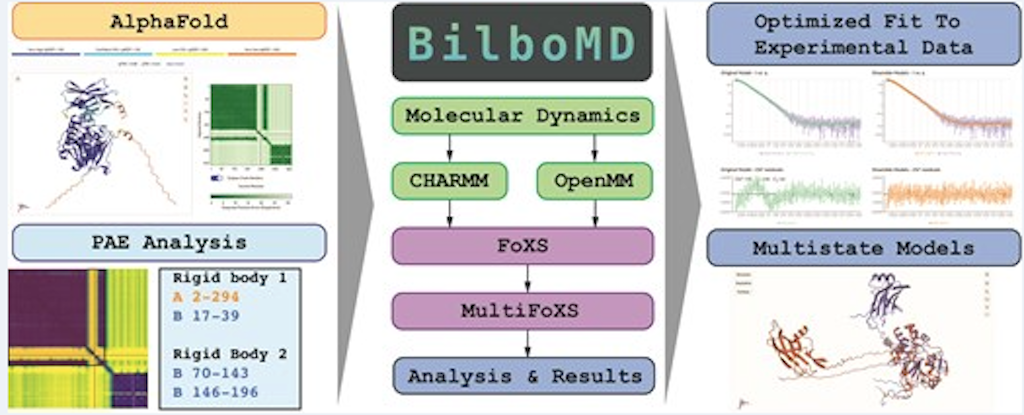
Thumbnail image for MES_validation.jpg In a recent article in the General Physiology and Biophysics we describe an analysis tool using relatively inexpensive small angle X-ray scattering (SAXS) measurements to identify protein flexibility and validate a constructed minimal ensemble of models, which represent highly populated conformations in solution. The resolution of these results is sufficient to address the questions being asked: what kinds of conformations do the domains sample in solution? In our rigid body modeling strategy BILBOMD molecular dynamics (MD) simulations are used to explore conformational space. A common strategy is to perform the MD simulation on the domains connections at very high temperature, where the additional kinetic energy prevents the molecule from becoming trapped in a local minimum. The MD simulations provide an ensemble of molecular models from which a SAXS curve is calculated and compared to the experimental curve.
A genetic algorithm is used to identify the minimal ensemble (minimal ensemble search, MES  ) required to best fit the experimental data.


Atl1_Nature_Fig.pngJulie Tubbs from John Tainer's group at Scripps published a totally sweet paper in the June 11, 2009 issue of Nature demonstrating that the ATL protein uses nucleotide flipping to link alkylated base damage to the nucleotide excision repair pathway. This publication was in part made possible by the SIBYLS beamline. 

Abstract:
Alkyltransferase-like proteins (ATLs) share functional motifs with the cancer chemotherapy target O(6)-alkylguanine-DNA alkyltransferase (AGT) and paradoxically protect cells from the biological effects of DNA alkylation damage, despite lacking the reactive cysteine and alkyltransferase activity of AGT. Here we determine Schizosaccharomyces pombe ATL structures without and with damaged DNA containing the endogenous lesion O(6)-methylguanine or cigarette-smoke-derived O(6)-4-(3-pyridyl)-4-oxobutylguanine. These results reveal non-enzymatic DNA nucleotide flipping plus increased DNA distortion and binding pocket size compared to AGT. Our analysis of lesion-binding site conservation identifies new ATLs in sea anemone and ancestral archaea, indicating that ATL interactions are ancestral to present-day repair pathways in all domains of life. Genetic connections to mammalian XPG (also known as ERCC5) and ERCC1 in S. pombe homologues Rad13 and Swi10 and biochemical interactions with Escherichia coli UvrA and UvrC combined with structural results reveal that ATLs sculpt alkylated DNA to create a genetic and structural intersection of base damage processing with nucleotide excision repair.

Tubbs JL, Latypov V, Kanugula S, Butt A, Melikishvili M, Kraehenbuehl R, Fleck O, Marriott A, Watson AJ, Verbeek B, McGown G, Thorncroft M, Santibanez-Koref MF, Millington C, Arvai AS, Kroeger MD, Peterson LA, Williams DM, Fried MG, Margison GP, Pegg AE, Tainer JA. "Flipping of alkylated DNA damage bridges base and nucleotide excision repair." Nature. 2009 Jun 11;459(7248):808-13.
link out

For older browsers, or non-flash enabled mobile browsers, we offer the old skool status page which has convenient small png files showing the last 24 hours of beamline data, but if you want to have a hands-on experience you might want to try out our new Google-style annotated time lines. If you're familiar with the Google finance web page where you can zoom in and explore the historical trends of the worlds financial markets you'll understand the coolness of this new tool.

izero_example.png

xpd.png
The structure of XPD was solved using data collected at the SIBYLS beamline and published in Cell this past summer. Recently this outstanding work was featured in the ALS Science Highlights.

"XPD helicase is an enzyme that unwinds the DNA double helix; it is one component of an essential repair mechanism that maintains the integrity of DNA. XPD is unique, however, in that pinpoint mutations of this single protein are responsible for three different human diseases: in xeroderma pigmentosum (XP), extreme sensitivity to sunlight promotes cancer; Cockayne syndrome (CS) involves stunted growth and premature aging; trichothiodystrophy (TTD), characterized by brittle hair and scaly skin, is another form of greatly accelerated aging. At the ALS, researchers from Berkeley Lab and The Scripps Research Institute recently solved the structure of XPD. The structure gives novel insight into the processes of aging and cancer by revealing how discrete flaws--as seemingly insignificant as a change in either of two adjacent amino acid residues--can lead to diseases with completely different physical manifestations."

Li Fan, Jill O Fuss, Quen J Cheng, Andrew S Arvai, Michal Hammel, Victoria A Roberts, Priscilla K Cooper, John A Tainer. "XPD helicase structures and activities: insights into the cancer and aging phenotypes from XPD mutations." Cell (2008) vol. 133 (5) pp. 789-800
In the March 2009 Journal of Synchrotron Radiation special issue on radiation damage, in addition to authoring two papers, our illustrious James Holton's ankle appears on the cover!

The first paper deals with the practical aspects of controlling and understanding radiation damage and will be very interesting to crystallographers who would like to collect data more intelligently.

Holton J.M. "A beginner's guide to radiation damage" Journal of Synchrotron Radiation 2009;16(2):133-142

bigjsr.gif
ABSTRACT:
Many advances in the understanding of radiation damage to protein crystals, particularly at cryogenic temperatures, have been made in recent years, but with this comes an expanding literature, and, to the new breed of protein crystallographer who is not really interested in X-ray physics or radiation chemistry but just wants to solve a biologically relevant structure, the technical nature and breadth of this literature can be daunting. The purpose of this paper is to serve as a rough guide to radiation damage issues, and to provide references to the more exacting and detailed work. No attempt has been made to report precise numbers (a factor of two is considered satisfactory), and, since there are aspects of radiation damage that are demonstrably unpredictable, the "worst case scenario" as well as the "average crystal" are discussed in terms of the practicalities of data collection.

The second paper deals with the intricacies of accurately measuring and comparing photon flux at different synchrotron beamlines using different PIN diodes and is more geared towards the beamline scientist.

Owen R.L., Holton J.M., Schulze-Briese C. and Garman E.F. "Determination of X-ray flux using silicon pin diodes." Journal of Synchrotron Radiation 2009;16(2):143-151

ABSTRACT:
Accurate measurement of photon flux from an X-ray source, a parameter required to calculate the dose absorbed by the sample, is not yet routinely available at macromolecular crystallography beamlines. The development of a model for determining the photon flux incident on pin diodes is described here, and has been tested on the macromolecular crystallography beamlines at both the Swiss Light Source, Villigen, Switzerland, and the Advanced Light Source, Berkeley, USA, at energies between 4 and 18 keV. These experiments have shown that a simple model based on energy deposition in silicon is sufficient for determining the flux incident on high-quality silicon pin diodes. The derivation and validation of this model is presented, and a web-based tool for the use of the macromolecular crystallography and wider synchrotron community is introduced.
The SIBYLS beamline has recently been awarded 50,000 hours on the NERSC (National Energy Research Scientific Computing Center) to perform solution structure modeling using experimental SAXS data. Besides the usual ab-initio reconstructions programs a new approach in rigid body modeling BILBOMD has been parallelized on the NERSC supercomputer. It is commonly acknowledged that flexibility between domains of proteins is often critical for function. These motions, and proteins with large scale flexibility in general, are often not readily amenable to conventional structural analysis such as X-ray crystallography, NMR, or electron microscopy. We have developed an analysis tool using experimental SAXS measurements to identify flexibility and validate a constructed minimal ensemble of models which represent highly populated conformations in solution. The resolution is sufficient to address questions about the extent of the domain conformational sampling in solution? In our rigid body modeling strategy BILBOMD, molecular dynamics (MD) simulations are used to explore conformational space. A typical experiment involves  MD simulation on the domain connections at very high temperature, where the additional kinetic energy prevents the molecule from becoming trapped in a local minimum. The MD simulations provide an ensemble of molecular models from which a SAXS curve is calculated and compared to the experimental curve. A genetic algorithm is then used to identify the minimal ensemble (Minimal Ensemble Search, MES) required to best fit the experimental data. If you are interested in learning about and/or using this valuable SAXS analysis tool please contact Michal Hammel (MHammel at lbl dot gov).

ALS Ring Status

loading ...

Funding

Photos

  • MES_validation.jpg
  • Atl1_Nature_Fig.png
  • izero_example.png
  • BilboMD2.jpg
  • BilboMD2.gif
  • xpd.png
  • bigjsr.gif
  • ApSOD_SAXS_result.png
  • q315r_good_gain_2s.png
  • q315r_bad_gain_2s.png
Powered by Movable Type 4.25